
China Giant Press Brake Technology for Heavy Metal Fabrication
2026-10-15
When it comes to bending thick, unforgiving steel plates, most fabricators quietly accept the limits of conventional press brakes. But what if your heavy metal fabrication could move faster, hold tighter tolerances, and handle massive workpieces without breaking a sweat? That’s the reality driving China’s giant press brake revolution—and at the center of it is HUNSONE, a name that keeps surfacing in high-capacity bending shops. In this post, we’ll pull back the curtain on the engineering breakthroughs, the tonnage wars, and the smart control systems that let these behemoths bend 20-foot plates like origami. Whether you’re upgrading a job shop or running a structural steel line, the next few minutes might change how you think about heavy metal forming.
China's Heavy-Duty Press Brakes Recast the Rules
Walk into any modern fabrication shop and you'll find a quiet shift taking place. The massive press brakes once imported from Europe are now being pushed aside by machines built in China, and the reason goes beyond price. These heavy-duty press brakes are being engineered with a level of precision and durability that wasn't expected a decade ago. From the way the frames are welded to the proprietary control systems that anticipate material springback, Chinese manufacturers have rewritten what a press brake can do under continuous, high-tonnage work.
What really changes the game is how these machines handle thick, high-strength steel without complaining. Older assumptions held that Chinese equipment would wear out faster or drift out of tolerance, but the new generation of heavy-duty press brakes uses hardened tooling, adaptive crowning, and real-time angle correction to hold repeatability within a few microns. Shops that used to keep a European brake for critical jobs are now running Chinese models on the same parts, often with faster setup times because the control interface is simpler and more intuitive.
The ripple effect is bigger than a single purchase decision. When a heavy-duty press brake from China can match or beat the bending performance of established brands, it forces the entire industry to rethink what they charge and what they promise. It also gives smaller fabricators access to capacity they never could have afforded, which in turn changes how jobs are quoted and how quickly prototypes move to production. The rules weren't just tweaked—they were recast around a new reality where Chinese engineering sets the benchmark for heavy bending.
Deflection Control at 3,000 Tons
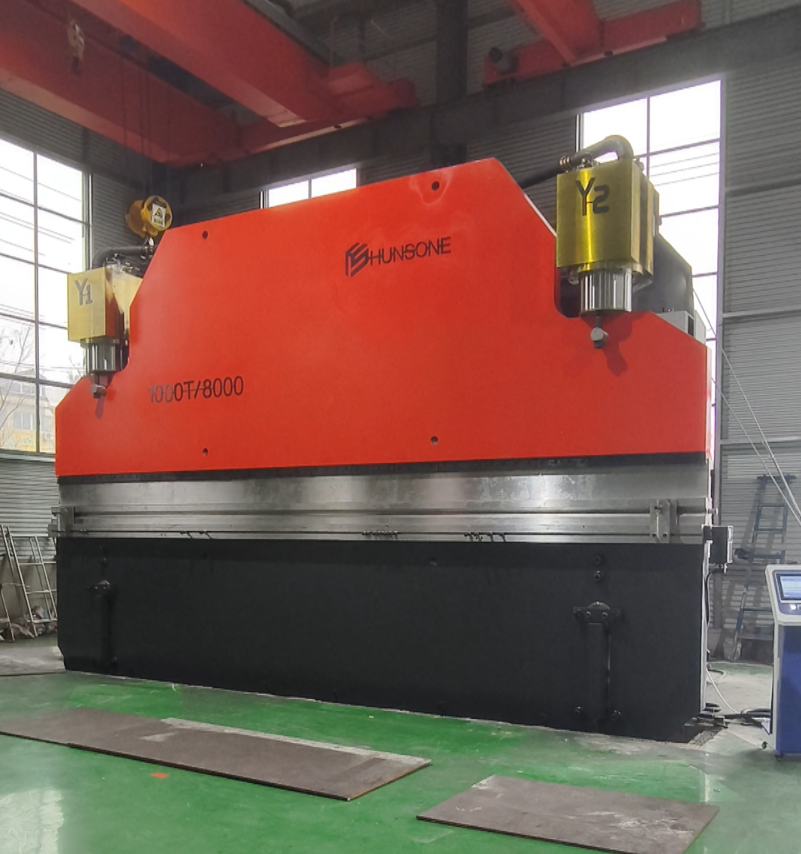
At full 3,000-ton load, the bed and ram don’t simply flex—they breathe. Controlling deflection here isn’t about chasing zero movement; it’s about keeping every micron of displacement predictable so the die gap stays uniform across the entire work surface. We map the stiffness under actual press force rather than relying on catalogue numbers, because a crown calculation from a clean-sheet spec rarely survives first contact with an offset load.
The real work happens at the corners and under short dies, where off-center tonnage tries to tilt the ram and smear the part. By pairing box-section crossheads with deliberately placed strain gauges, the control loop adjusts before the frame’s elastic response translates into dimensional drift. That means a 3,000-ton hit feels the same at the edge of the bed as it does dead center—not just in theory, but on parts measured after the stroke.
Hydraulics Engineered for Continuous Heavy Lifting
When a lift has to happen every hour, not just once a week, the difference between a good hydraulic system and a great one shows up fast. Continuous heavy lifting punishes weak seals, flexes undersized cylinders, and cooks hydraulic fluid that wasn't chosen for sustained load. We design for that reality, starting with oversized rod diameters and honed barrel coatings that keep friction low while pressure stays high. Every circuit path is mapped for heat rejection, not just peak force, because a cylinder that never gets a break can't afford to run at the edge of its thermal limit.
Rather than stacking standard components and hoping they hold, we tune the whole loop: pump displacement matched to cylinder volume, valve spools profiled for smooth reversals under full load, and filtration placed where contamination actually enters — not where it's easy to mount. The result is a lifting package that doesn't sag after a thousand cycles, doesn't foam the reservoir on a hot afternoon, and doesn't ask the operator to baby it. If the application calls for three shifts of nonstop hoisting, the hydraulics should be the least of your worries.
What separates continuous-duty rigs from intermittent ones is less about brand names and more about honest derating. We run every assembly through a simulated duty cycle that includes cold starts, stalled loads, and pressure spikes from emergency stops. Only after the temperature curve stays flat and the internal leakage stays below threshold do we call it ready. That's why the same cylinder you see on a steel mill manipulator also turns up on ship unloaders and forging manipulators — places where downtime costs more than the equipment itself.
Precision Bending Without Sacrificing Power
The usual assumption in bending is that tight tolerances demand a gentler touch, which quietly drains the force you need for heavier stock. That trade-off falls apart the moment you watch a modern press brake hold a bend angle within a fraction of a degree while the ram delivers full tonnage. The secret is not in choosing between finesse and muscle, but in controlling how the power is released. Closed-loop feedback reads the frame deflection and adjusts pressure on the fly, so the tooling follows the exact path you programmed instead of drifting under load.
What separates this from older hydraulic systems is the way force ramps up only when the material actually resists. The machine can approach the workpiece quickly at low pressure, then shift into a high-pressure hold precisely at the point of contact. That means you get a crisp, stable bend without the spring-back that comes from an uncontrolled surge. The result feels less like overpowering the metal and more like guiding it into position, even on thick plate or high-tensile alloys.
For operators, this changes the daily rhythm. You stop compensating for drift with shims or second-pass corrections, because the first bend already matches the print. Complex parts with multiple flanges hold their geometry across the entire run, and you don't need to dial down the tonnage limit just to protect a delicate profile. Power and precision stop being separate settings and become one continuous response from the machine.
Tooling That Survives Extreme Plate Thickness
When plate thickness climbs past 40 mm, most tooling starts to show its limits in ways that spec sheets rarely capture. The real challenge isn't just brute force—it's the way thick plate concentrates load at the cutting edge and transfers shock back through the punch body. Tooling that survives here tends to share a few unglamorous traits: oversized shear angles cut in steps rather than one continuous slope, punch stems with a slight taper to shed stress before it reaches the retainer, and steel that keeps a hard case without turning brittle at the core. These details matter more than raw tonnage ratings.
Heat treatment is where a lot of tooling either earns its keep or fails early. A deep, uniform case on a shock-resistant tool steel can hold an edge through hundreds of hits in 50 mm plate, but only if the transition zone is gradual enough to prevent spalling under repeated impact. Some shops also turn to split punch designs—two or three narrower segments working in sequence—so that no single point ever takes the full width of the cut at once. That approach, combined with guided strippers that keep the punch from deflecting on entry, is often the difference between a tool that needs constant shimming and one that runs a full shift without attention.
Smart Automation for Large-Scale Metal Forming
Metal forming at scale has always balanced throughput against repeatability. Smart automation shifts that balance by embedding sensing and closed-loop control directly into presses, roll formers, and stamping lines. Instead of relying on periodic quality checks, the equipment adjusts parameters mid-run to compensate for material springback, tool wear, or temperature drift.
The practical result is fewer rejected batches and less downtime. For example, a servo press can vary slide motion within a single stroke, while vision systems measure part geometry immediately after forming. That data feeds back to actuators that fine-tune blank holder force or lubrication, which keeps dimensions stable across long production runs without operator intervention.
Over time, these systems accumulate process histories that help maintenance teams predict when dies or hydraulic components will degrade. This moves large-scale forming from reactive troubleshooting to planned, condition-based upkeep, which matters more as batch sizes shrink and material grades diversify.
FAQ
They often use synchronized multi-cylinder hydraulic systems and reinforced frames, with some machines delivering over 20,000 kN of force, allowing them to bend steel plates thicker than 50 mm without compromising straightness.
Beyond sheer size, these brakes integrate crowning systems that automatically compensate for deflection under load, plus adaptive angle correction based on real-time thickness and tensile strength data from the sheet.
They offer a rare combination of high tonnage capacity and modular design, meaning a single machine can be reconfigured for different beam lengths and tooling setups, which cuts downtime when switching between hull plates and bridge girders.
Many models use laser-based angle monitoring and servo-driven backgauges, holding repeatability within ±0.1 degrees even on parts exceeding 10 meters, which reduces the need for manual shimming or test bends.
High-strength low-alloy steels, abrasion-resistant plate, and even pre-cut stainless or aluminum composites in thicknesses from 6 mm up to 60 mm or more, depending on the die opening and machine rating.
Yes, several newer systems replace constant-running hydraulic pumps with variable-frequency drives and regenerative circuits, so power draw matches the bending cycle demand, which can cut idle energy consumption by 30 to 40 percent.
Reputable builders provide finite element analysis reports on the frame and ram, plus full-load deflection tests with dial indicators along the bed, and some also offer third-party certification for welding and alignment tolerances.
Quick-clamp upper tools and segmented lower dies with hydraulic clamping allow operators to switch between sharp V-bends and large-radius forming in under 15 minutes, which is critical for job shops handling mixed plate work.
Conclusion
China's giant press brake technology has moved beyond raw tonnage into a realm where precision and endurance coexist under extreme loads. The current generation of 3,000-ton machines no longer forces fabricators to choose between force and accuracy. Active deflection control keeps the ram and bed parallel even at full capacity, virtually eliminating the angular inconsistencies that once plagued thick-plate bending. This shift is rewriting expectations across shipyards, bridge builders, and energy infrastructure projects, where oversized components demand repeatable geometry rather than just brute force.
The hydraulic systems behind these presses are engineered for nonstop heavy lifting, maintaining consistent pressure and speed through long production runs without overheating or drift. Precision bending is achieved through smarter control loops that adjust in real time, so power never comes at the expense of tight tolerances. Tooling has also evolved: new alloys and heat treatments allow dies and punches to survive repeated contact with extreme plate thickness, cutting downtime and tool replacement costs. On top of that, smart automation now handles material positioning, angle monitoring, and adaptive correction, turning large-scale metal forming from an artisanal skill into a controlled, data-driven process. Together, these advances mean China's heavy-duty press brakes deliver not just tons of force, but reliable, deep-draw quality across the most demanding fabrication tasks.
Contact Us
Contact Person: James Chen
Email: [email protected]
Tel/WhatsApp: 86 13770803946
Website: https://www.hunsone.com/