

China Hollow Wall Winding Pipe Machine Benefits and Key Buying Considerations
2026-11-16
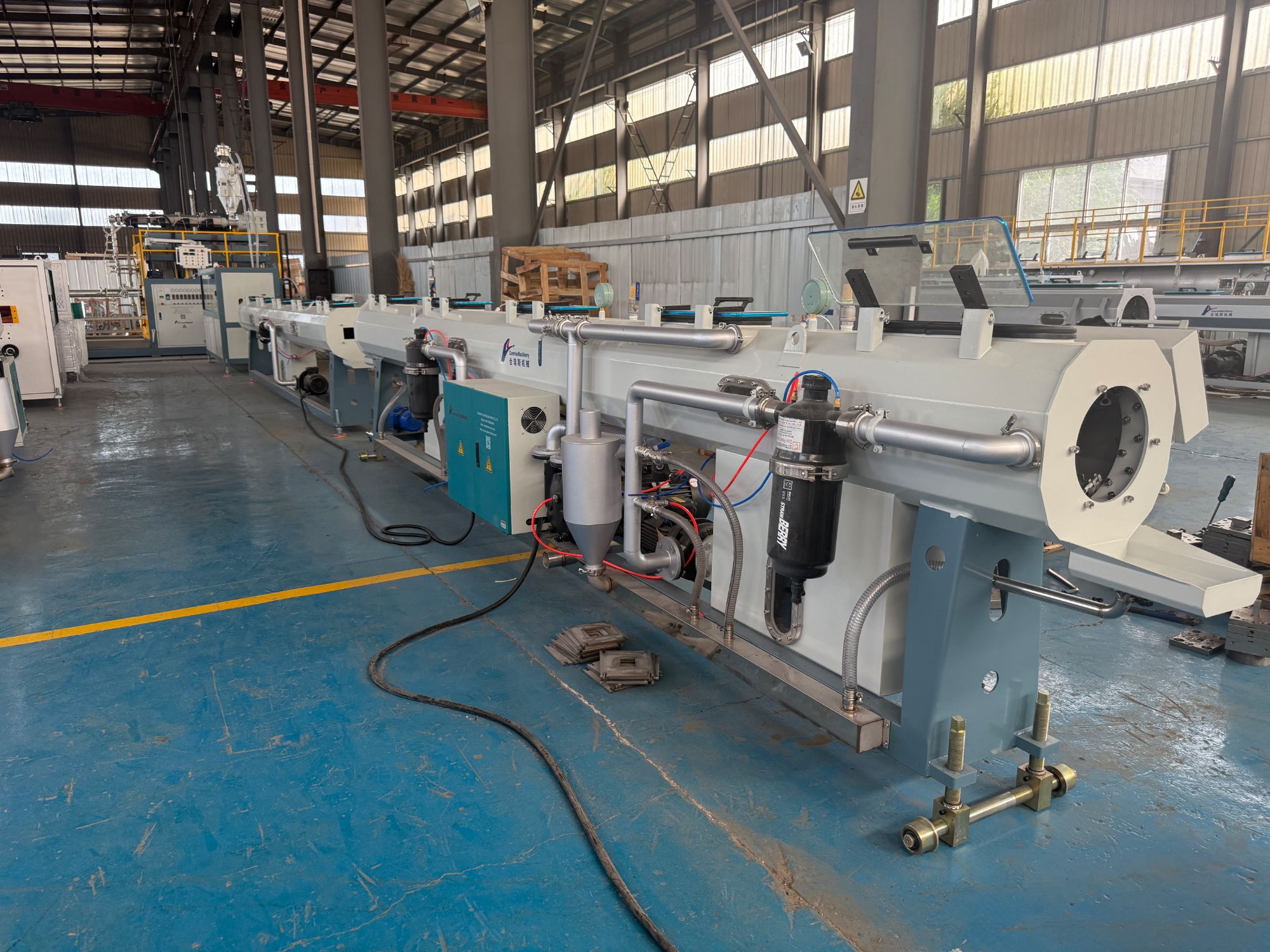
Most buyers still treat hollow wall winding pipe machines like a commodity purchase. That is how costly surprises happen. Not all machines coming out of China are built the same, and differences in screw design, cooling, and control systems show up quickly in wall consistency and downtime. Before you compare prices, it helps to separate real engineering advantages from sales talk. In this guide, we will walk through the benefits that actually matter on a production floor and the buying factors that are easy to overlook. We will also look at how COMRISE approaches these machines.
Where Hollow Wall Winding Lines Reduce Cost per Meter
Hollow wall winding lines show the sharpest cost-per-meter reductions on cylindrical vessels and large-diameter pipe runs where continuous filament winding replaces segmented steel or precast concrete. On these shapes, the winding head travels without constant starts and stops, so material placement stays even and the wall builds up with far less handling and fewer joints per linear meter.
Remote tank farms and mining slurry lines are another area where the economics shift quickly. Transporting prefabricated sections to these sites often costs more than the sections themselves. A mobile winding setup can place a hollow wall directly against an existing shell or mandrel, cutting freight, crane time, and weld inspection hours out of the per-meter figure.
The benefit also appears in relining work for aging penstocks, culverts, and chemical storage tubes. Instead of removing the old structure and building new, crews wind a structural liner inside the existing diameter. Because the old shell stays in place as formwork and temporary support, the per-meter cost drops compared to open-trench replacement or full demolition.
How Wall Profile Design Changes Stiffness and Material Demand
Wall profiles do far more than define a part's outer shape. Even small shifts in rib spacing, draft angle, or wall thickness distribution alter how bending loads travel through a component. A thin vertical wall with closely spaced stiffening ribs may weigh less than a thick flat wall, yet carry the same moment with far less deflection. The reason is simple: stiffness scales with the cube of thickness in flat plates, but when you fold that plate into ribs, you add geometric depth without adding material across the full footprint. This lets designers push stiffness up while keeping cycle time and part weight in check.
Changes in profile geometry also reshape material demand in ways that are easy to overlook. A deep, narrow channel can replace a wide, shallow one, improving section modulus while cutting resin volume. However, draft angles, corner radii, and wall transitions often introduce local thickening that cancels out some of those savings. The real skill lies in balancing rib height against base wall thickness: too tall a rib may trigger sink marks or filling hesitation, pushing processors toward higher pack pressures and longer cooling times. Those indirect costs show up as increased material usage per shot, even when the nominal part volume drops.
Iterative adjustment of wall profile design is rarely linear. Moving a stiffener by a few millimetres can shift the neutral axis enough to halve peak stress, allowing a further reduction in wall stock. Conversely, flattening a profile to simplify tooling often forces a jump in nominal thickness to recover lost stiffness, which raises both shot weight and warpage risk. Practical design work therefore treats the cross-section as a system: rib placement, transitions, and draft all interact, and the most material-efficient shape is usually one that uses modest, well-distributed geometric depth rather than relying on heavy uniform walls.
What Chinese Manufacturing Quality Looks Like in This Niche
Quality here rarely announces itself through branded packaging or glossy certificates. It shows up in quieter details: the edge of a pressed housing that has been deburred twice, a thread insert seated at the right depth, or a batch number written in paint that does not smudge after a week in humidity. Factories that last in this niche tend to be obsessive about a narrow range of processes rather than trying to look impressive across the board.
Materials are where the gap becomes obvious. The better workshops keep tight control over their incoming stock, often working with the same two or three local suppliers for years. That consistency means a run produced in March behaves the same as one produced in November. It is not glamorous, but it is the kind of reliability that buyers learn to recognize after the first rejected shipment from a cheaper source.
Inspection is embedded in the workflow instead of being treated as a final gate. Workers check dimensions at the machine, supervisors pull random pieces for destructive testing, and finished lots get held for a short settling period before packing. The result is rarely flawless in a cosmetic sense. What stands out is predictability: you know what will arrive, how long it will last, and where the acceptable variation sits.
Reading Machine Specs for the Pipe Sizes You Actually Run
A machine that can swallow a 24-inch pipe on paper doesn't always behave the same when you're running 6-inch day after day. The numbers worth highlighting are the ones tied to your most common diameter range, not the absolute maximum. Look at clamping force, torque curve, and ram or screw speed at the sizes you actually quote, because that's where cycle time and scrap rate get decided.
It helps to pull the performance curves instead of relying on the headline capacity. A drive may be rated for a wide range, but the sweet spot often sits in a narrower band. If the chart shows stable melt pressure or consistent wall thickness only between certain diameters, treat that as your real operating window. Anything outside it can still work, just with more adjustment and more risk.
Also check how the cooling and downstream handling are sized for the middle of your range. Oversized tanks and haul-offs tend to mask problems on big pipe, while undersized ones punish you on small, fast runs. Reading the machine this way, around the work you actually do, gives you a better feel for whether it will hold tolerance without constant babysitting.
Control System Checks That Affect Changeover and Scrap Rates
Operators often treat control system checks as a box-ticking exercise, yet the way sensors are calibrated directly shapes how much material ends up in the scrap bin. A drift of just a few millivolts in a temperature probe or a lagging pressure transducer can push a process outside its tolerance window during the first minutes of a changeover. Instead of waiting for the quality lab to flag a bad batch, forward-thinking teams compare live control loop outputs against the last three stable runs before the line is handed back to production. That small habit catches issues like a sticky valve or a worn thermocouple that would otherwise only surface as unexplained waste an hour later.
The real cost shows up when changeovers are rushed and control parameters are loaded from an older recipe without checking the current state of actuators. A positioner that does not fully seat, or a flow meter with a fouled electrode, may still pass a basic loop test but fail under dynamic conditions. By adding a short sequence that ramps each critical loop through 20%, 50%, and 80% of its range while logging response time and overshoot, maintenance crews can spot degraded performance that static checks miss. This preemptive approach reduces the scrap spike that typically follows a product switch, because the system is verified against actual mechanical movement rather than just software setpoints.
Another overlooked factor is the interaction between control loops after a changeover. A tuning constant that worked for the previous product can cause oscillation when the new material has a different viscosity or heat capacity. Rather than re-tuning everything from scratch, experienced engineers keep a short list of loops that historically fight each other—such as a jacket temperature controller and a feed rate controller—and watch their trends for the first ten cycles. Catching an unstable interaction early means the difference between adjusting one gain value and scrapping an entire shift’s worth of edge trim or off-spec film.
Spare Parts Access and Service Response Before You Commit
Before you sign anything, ask how spare parts actually reach you when something breaks. A machine sitting idle for three days while a courier chases a part number is not a minor inconvenience—it's a direct hit to your schedule and your margin. Look for a supplier who can show you a stock list, not just a promise, and who knows which components fail most often in your type of operation. That kind of detail tells you they've watched their equipment work long after the sale.
Service response time matters less than response quality. A technician who arrives fast but opens the manual for the first time is worse than one who takes an extra hour but knows the torque spec from memory. Ask for a realistic on-site window, then ask what they do when they can't meet it. Do they have a loaner program? A local partner? The answer usually reveals whether their support network is built for your region or just drawn on a brochure map.
Finally, test their communication before you commit. Send a routine question about a grease interval or a filter cross-reference and see how long it takes to get a useful answer. If the pre-sale response is slow or vague, the post-sale response won't improve once you've paid. A supplier who treats a basic inquiry with care is the same one you'll want on the phone at 6 a.m. when a pump seizes.
FAQ
Most buyers find the upfront cost is lower without a corresponding drop in output stability. Chinese manufacturers have refined the extrusion and winding units over years of high-volume production, so the equipment tends to be straightforward to operate and easier to maintain locally.
The pipes they produce are commonly used for stormwater drainage, sewage collection, and agricultural water transfer. Because the hollow wall design gives good ring stiffness with less material, the pipes work well in buried gravity-flow systems where light weight and long runs matter.
Look closely at the screw and barrel combination, not just the quoted diameter range. A well-matched screw can handle recycled HDPE without constant surging, while a poorly matched one leads to uneven wall thickness and wasted resin.
It often decides how much operator attention the line needs. A rigid winding frame with accurate roller positioning holds the pipe round during cooling, reducing the need for manual adjustments between size changes.
Energy consumption and spare parts availability tend to be underestimated. A cheaper line may use older motors and heaters that raise running costs, and if common wear parts are not stocked locally, downtime can erase the initial savings.
Many can, but it is not universal. If recycled feedstock is part of your plan, ask for a feeding and venting setup that handles moisture and contaminants; otherwise you may see bubbles or weak spots in the pipe wall.
The willingness to provide detailed commissioning support and clear operating documentation matters more than a long warranty promise. A supplier that sends an experienced technician for startup and training can get a new line running correctly within days instead of weeks.
Regular cleaning of the melt filter, checking roller alignment, and keeping the cooling system free of scale are the basics. Most plants also benefit from weekly inspections of the heater bands and screw wear using a simple log rather than waiting for a failure.
Conclusion
Cost per meter shifts most when the winding line matches the wall profile to the pipe diameters you actually sell instead of chasing a wide spec sheet. A lighter corrugated profile with correct pitch holds ring stiffness without loading extra polymer into every meter, and that directly lowers raw material draw per length. The practical difference between machines often appears in how quickly the control system settles after a size change; a line that stores proven recipes and keeps barrel temperatures stable during changeover avoids the usual stretch of scrap tubing produced while operators dial settings back in. This is where careful spec reading pays off before the purchase.
Chinese manufacturing in this niche varies less by province than by factory discipline around welding, stress relief, and how the screw and barrel are matched to recycled or mixed feedstock. Before committing, read the specification for the diameter and wall thickness band you run most often, not the maximum envelope. Ask for a realistic spare parts list covering wear items, and test how the supplier handles a service question before payment, because response time after installation matters more than warranty wording. A machine supported with local stock for screws, heaters, and calibration sleeves will keep cost per meter predictable, and that support network often determines whether a small issue becomes a two-day delay or a two-week stop.
Contact Us
Contact Person: LISA LEE
Email: [email protected]
Tel/WhatsApp: +86 13780696467
Website: https://www.qdpipemachine.com