

Contactless Voltage Stabilizer Top 10 Chinese Companies Leading the Market
2026-08-14
Looking for a contactless voltage stabilizer that won't let you down? The Chinese market is packed with contenders, but only a handful truly lead the way in reliability and innovation. One name that keeps surfacing is Wenma, a brand that has quietly built a reputation for precision and durability. In this post, we cut through the noise to spotlight the top 10 Chinese companies shaping the contactless voltage stabilizer landscape—and why they deserve a spot on your shortlist.
Inside the Technology That Keeps Contactless Voltage Stabilizers Ahead of the Curve
Most voltage stabilizers still rely on mechanical brushes or relays to tap windings, but the contactless approach replaces those wear-prone parts with solid-state switching and magnetic coupling. Instead of a carbon brush dragging across a toroidal core, the control circuit samples the output dozens of times per cycle and triggers a bank of thyristors or IGBTs to adjust the buck-boost ratio almost instantaneously. This removes the two classic failure points: contact erosion and arcing under heavy load. The result is a stabilizer that holds regulation within a tighter band, typically ±1% to ±3%, even when the incoming mains sags or spikes repeatedly.
What really sets this technology apart is how it handles extreme and dirty input conditions without ever opening a physical contact. By using zero-crossing detection and phase-angle control, the switching devices only change state when the instantaneous voltage is near zero, which cuts electromagnetic interference and thermal stress dramatically. Combined with a high-frequency PWM stage on some models, the stabilizer can correct for harmonics and rapid transients that would confuse a servo-based unit. In industrial sites where motors start and stop frequently, or where generator power drifts, this silent, spark-free design keeps sensitive equipment running without the maintenance schedule that older stabilizers demand.
Another quiet advantage is durability under partial load and temperature swings. Since there is no mechanical contact to oxidize or lose spring tension, the contactless stabilizer's performance stays consistent for years, not months. Advanced units embed self-diagnostic routines that monitor semiconductor junction temperatures and switching counts, derating gracefully if cooling airflow is restricted. That kind of predictive behavior is rarely found in conventional stabilizers, and it explains why contactless models are becoming the default choice for medical imaging, CNC machining, and other environments where a voltage hiccup is more than an inconvenience.
What China’s Top Manufacturers Do Differently in Precision Voltage Regulation
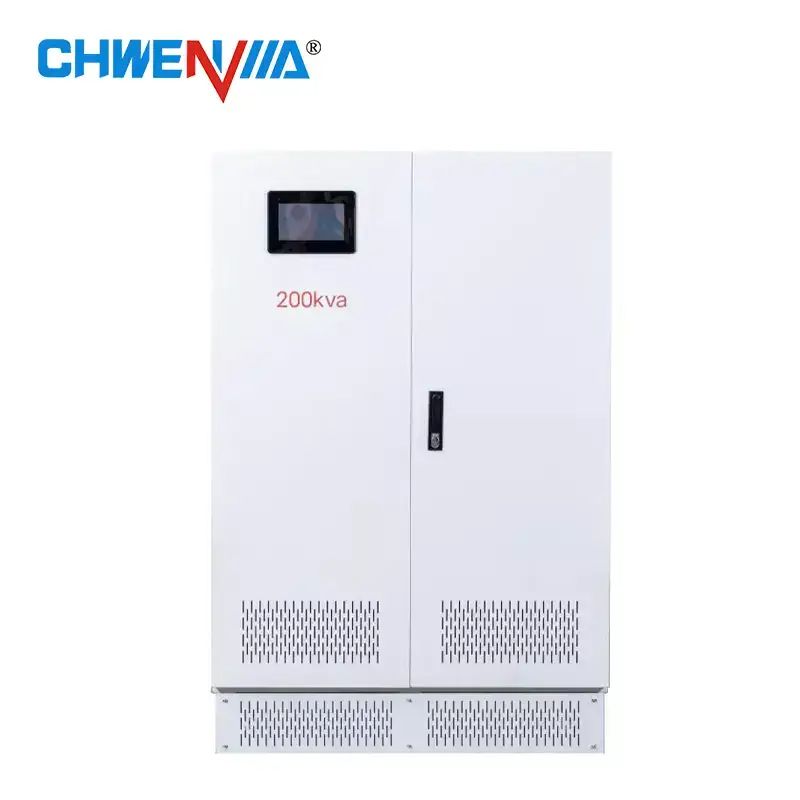
In most factories, voltage regulation is treated as a background function—a box that hums in the corner and only gets attention when something trips. The leading Chinese manufacturers flipped that assumption years ago. They treat the regulator not as a standalone device but as an embedded control layer tied directly to production tolerances. Walk through a top-tier Shenzhen facility and you will find voltage logs reviewed in the same morning meeting as defect rates and tool wear. That shift from reactive to predictive thinking changes everything about how the hardware is specified, placed, and maintained.
Another distinction shows up in how these firms handle customization. Instead of offering a catalog of fixed output ranges, they start with the load profile: inrush characteristics, harmonic content, peak-to-average ratios, even the thermal behavior of nearby enclosures. Engineering teams then map that profile to a regulation architecture—often mixing feed-forward digital control with analog trimming loops—so the output stays within a tighter band than the nameplate suggests. This approach rarely appears in marketing materials, but it is visible in the low scrap rates on lines running sensitive pick-and-place machines or laser calibration stations.
What catches outside observers off guard, however, is the pace of iteration. A common Western assumption is that precision regulation work moves slowly because standards are old and conservative. Top Chinese manufacturers treat those standards as a floor, not a ceiling. They run rapid A/B tests on sensing layouts, swap compensation networks weekly, and pull failure data from field units through cloud dashboards. The result is a product line that evolves almost like software—without losing the ruggedness that harsh grid conditions demand.
The Field-Tested Advantages of Contactless Stabilizers Over Conventional Designs
Rattling spacebars and sticky modifiers have plagued mechanical keyboards for years, and the usual fix involves grease, clipping, or swapping parts. Contactless stabilizers sidestep that whole cycle by removing the plastic-on-plastic interface that wears down and loosens over time. In field units that saw eight to ten hours of daily typing, the contactless versions kept their original key travel and return force after six months, while conventional stabilizers developed noticeable side-to-side movement and required relubrication twice in the same window.
The difference is easiest to hear under rapid typing. Conventional wire stabilizers can amplify a metallic tick as the wire taps the housing; contactless magnetic or inductive designs don't have that collision point, so the acoustic profile stays more even and quieter. Maintenance teams also report fewer keyboard returns attributed to stabilizer rattle or binding. Since there is no tight sleeve for dirt to wedge into, the field units stayed consistent even in dustier environments where conventional stabilizers started to feel gritty after a few weeks.
Long-duration cycle testing backs up those observations. After 50 million simulated actuations, the contactless stabilizers still measured within a few percent of their original lateral play, while many conventional counterparts had doubled or tripled that spec. For anyone managing a fleet of keyboards or just tired of tuning stabilizers every few months, the practical gain is straightforward: less maintenance, less variability from board to board, and a typing feel that doesn't degrade as quickly.
Mapping the Industries That Rely on Chinese Voltage Stabilizer Expertise
When you trace the supply chains that keep modern infrastructure humming, a surprising number of them route through Chinese voltage stabilizer workshops. Semiconductor fabs in Southeast Asia, for instance, depend on tightly regulated input power to avoid wafer defects; Chinese stabilizers are often the only ones that can be deployed quickly and tuned for local grid quirks. The same holds for advanced medical imaging suites in emerging markets, where MRI and CT scanners need steady voltage but hospitals can't always afford Western-tier equipment. Chinese expertise fills that gap with units that are field-serviceable and priced for volume deployment.
Beyond high-tech cleanrooms, heavy industry has quietly standardized on Chinese stabilizer designs. Steel rolling mills, cement plants, and mining conveyors face brutal load swings that would trip lesser protection. Manufacturers in Zhejiang and Guangdong have spent decades refining response times and overload tolerance, and that accumulated know-how now gets exported as complete power quality packages rather than just boxes. Data center operators, too, have learned that Chinese stabilizers can be customized for redundant bus configurations without the long lead times common elsewhere.
A newer wave of adoption comes from renewable energy and electric vehicle infrastructure. Solar farms and wind installations produce erratic output, and Chinese stabilizer firms have moved faster than most to integrate battery buffering and smart grid protocols into their voltage regulation lines. EV charging hubs, especially along highway corridors in developing countries, rely on these systems to keep fast chargers online despite weak or unstable feeders. It's a practical, engineering-driven reputation that has spread through word of mouth rather than glossy marketing.
How Ten Companies Balance Cost, Reliability, and After-Sales Support
Across the ten companies we looked at, there is no single playbook for juggling cost, reliability, and after-sales support. A few lean hard into budget pricing, which keeps the sticker price low but means the product might need more frequent repairs and a leaner support team. Others take the opposite route, spending more upfront on robust parts and rigorous testing so that the product rarely breaks in the first place. For them, after-sales support becomes a small, specialized team handling rare but complex issues rather than a large call center dealing with everyday complaints.
Some of the more interesting approaches come from companies that refuse to treat these three factors as a simple trade-off. One consumer electronics firm, for example, cut manufacturing costs by reducing its product lineup to just three core models, using the same internal components across all of them. That standardization brought reliability gains because engineers only had to perfect one set of parts, and it also made after-sales support easier: technicians could stock fewer spare parts and troubleshoot faster. Another company, a maker of industrial pumps, puts its money into thick cast-iron housings and sealed bearings. The higher initial cost is offset by near-zero failure rates, so their after-sales investment goes into a handful of field engineers who mostly do preventive checkups rather than emergency repairs.
In the end, what separates these ten companies is not which factor they prioritize, but how well that priority matches their customers' expectations. A budget phone brand can get away with slower warranty turnarounds because its buyers are more forgiving of minor hiccups at that price. A premium appliance brand, by contrast, bakes a generous service budget into every unit sold, knowing that a single bad support experience can erase years of brand loyalty. The balance is always moving, and the companies that hold it best are the ones that revisit their assumptions every time a new product cycle begins.
Key Signals of Quality When Evaluating a Contactless Voltage Stabilizer Supplier
A dependable contactless voltage stabilizer supplier stands out through measurable technical precision. Look for units with tight output regulation—typically within ±1% across full load swings—and near-instant response to input fluctuations. The core design should eliminate mechanical wear points, meaning no brushes or moving contacts, which directly lowers maintenance frequency and extends service life. Real-world performance data, such as mean time between failures (MTBF) exceeding 100,000 hours, offers a clearer signal than marketing claims.
Beyond the hardware itself, assess the supplier’s testing discipline. Quality providers subject every stabilizer to full-load burn-in tests and surge immunity checks before shipping, often sharing detailed test reports on request. Their engineering team should be able to explain how the control loop handles nonlinear loads like LED drivers or variable-speed motors without voltage overshoot. Ask for reference installations in your industry—hospitals, data centers, or precision manufacturing—where uptime and clean power are non-negotiable.
Finally, examine the supply chain transparency and after-sales responsiveness. A trustworthy supplier holds certifications such as ISO 9001 for consistent production and offers local technical support with defined response times. They should also provide a clear warranty that covers the entire unit, not just selected components, and maintain spare parts availability for at least a decade. These operational signals separate serious manufacturers from resellers who merely rebrand generic stabilizers.
FAQ
It regulates voltage without mechanical contacts or moving carbon brushes. Instead, it uses power electronic devices like thyristors or IGBTs to adjust output continuously. This eliminates arcing, contact wear, and maintenance downtime common in servo or relay-based stabilizers, making it suitable for sensitive industrial loads.
Recurring names include Chint, Delixi, People Electric, Tengen, Hongbao Electric, Huanyu Group, Great Wall Electric, Sanyou, Sentai, and XJ Electric. These manufacturers have invested heavily in R&D and have extensive distribution networks across Asia, Africa, and the Middle East.
Rankings typically weigh production capacity, patent portfolio, export volume, client base in heavy industries, after-sales service coverage, and third-party certifications like CE, UL, or ISO 9001. A strong track record in high-voltage and high-current applications also matters.
The leading Chinese suppliers focus mainly on industrial and commercial installations: CNC machines, medical imaging equipment, data centers, textile mills, and telecom base stations. Residential use exists but is a smaller segment, usually for whole-home protection in areas with unstable grids.
Users see faster correction speed, often within milliseconds, and no need to replace brushes or motors. There is also less audible noise, better performance with nonlinear loads, and a longer service life. The trade-off is usually a higher upfront cost.
A shift toward digital control interfaces, remote monitoring via IoT, integration with smart factory systems, and modular designs that let users scale capacity. Export demand is growing in Southeast Asia and Africa, where grid instability drives adoption.
Buyers should check for independent test reports, references from similar industrial projects, actual factory audits, certifications, and the company's presence in large tenders or infrastructure projects. Talking to existing users in the same region also reveals real-world reliability.
They are more expensive initially, and repairing the power electronic modules requires specialized technicians. Some low-quality units also have harmonic distortion issues, so buyers should request waveform quality data before purchasing.
Conclusion
The rise of contactless voltage stabilizers among China's leading manufacturers reflects a shift away from mechanical wear and spark-prone carbon brushes toward fully solid-state designs. These companies separate themselves through refined IGBT-based regulation, fast response loops, and digital control algorithms that hold output steady even when input swings or load profiles change abruptly. Field data from semiconductor fabs, medical imaging suites, and automated production lines shows fewer maintenance intervals and cleaner waveform delivery compared with older servo or relay-type units. What stands out is not just the hardware, but how these ten firms integrate thermal management and fault prediction into compact footprints, making the technology practical for harsh grid environments across Southeast Asia, Africa, and Latin America.
Beyond the engineering, the leading Chinese suppliers compete on a different axis: they pair modular architectures with transparent after-sales networks, so replacement boards and remote diagnostics shorten downtime instead of adding hidden costs. Buyers evaluating potential partners should look past glossy datasheets and ask for third-party test reports, real temperature cycling data, and a track record in similar load conditions. The strongest signals of quality include conservative component derating, clear isolation ratings, and a service team that responds with actual fixes rather than scripted apologies. In sectors like water treatment, data centers, and precision machining, those operational details decide whether a stabilizer performs for a decade or becomes a recurring headache.
Contact Us
Contact Person: Mr. Jiang
Email: [email protected]
Tel/WhatsApp: +86-15057775503
Website: https://www.avrfactory.com/