

Envelope Mailers Box Original Manufacturer – Custom Durable Packaging Solutions
2026-09-07
Most envelope mailers fail long before they reach your customer's hands. That's why sourcing directly from an original manufacturer matters. Kuaijie Carton specializes in custom, durable packaging solutions built for real-world shipping—without the markup of middlemen. Here's what sets their approach apart.
Why Our Envelope Mailers Start With Caliper-Tested Board Instead of Standard Stock
Most people never think about the thickness of the board inside an envelope mailer until one arrives with a crushed corner or a split seam. Standard stock can drift between production runs, and that drift shows up as mailers that fold too easily, tear at the score lines, or fail to protect what's inside.
We start with caliper-tested board because thickness matters more than weight or recycled content on their own. Each batch is measured at multiple points before cutting, so the board we feed into the die-cutter is the same density from edge to edge. That consistency keeps folds crisp and prevents the weak spots that come from uneven stock.
The difference is easiest to notice when you stack a pile of finished mailers. Standard stock tends to produce a mix of limp and stiff pieces, even within the same box. Caliper-tested board gives every mailer the same resistance to bending, which means fewer re-ships, fewer damaged contents, and less guesswork when you pick one up.
Custom Die-Lines That Match Your Product Before the First Cut
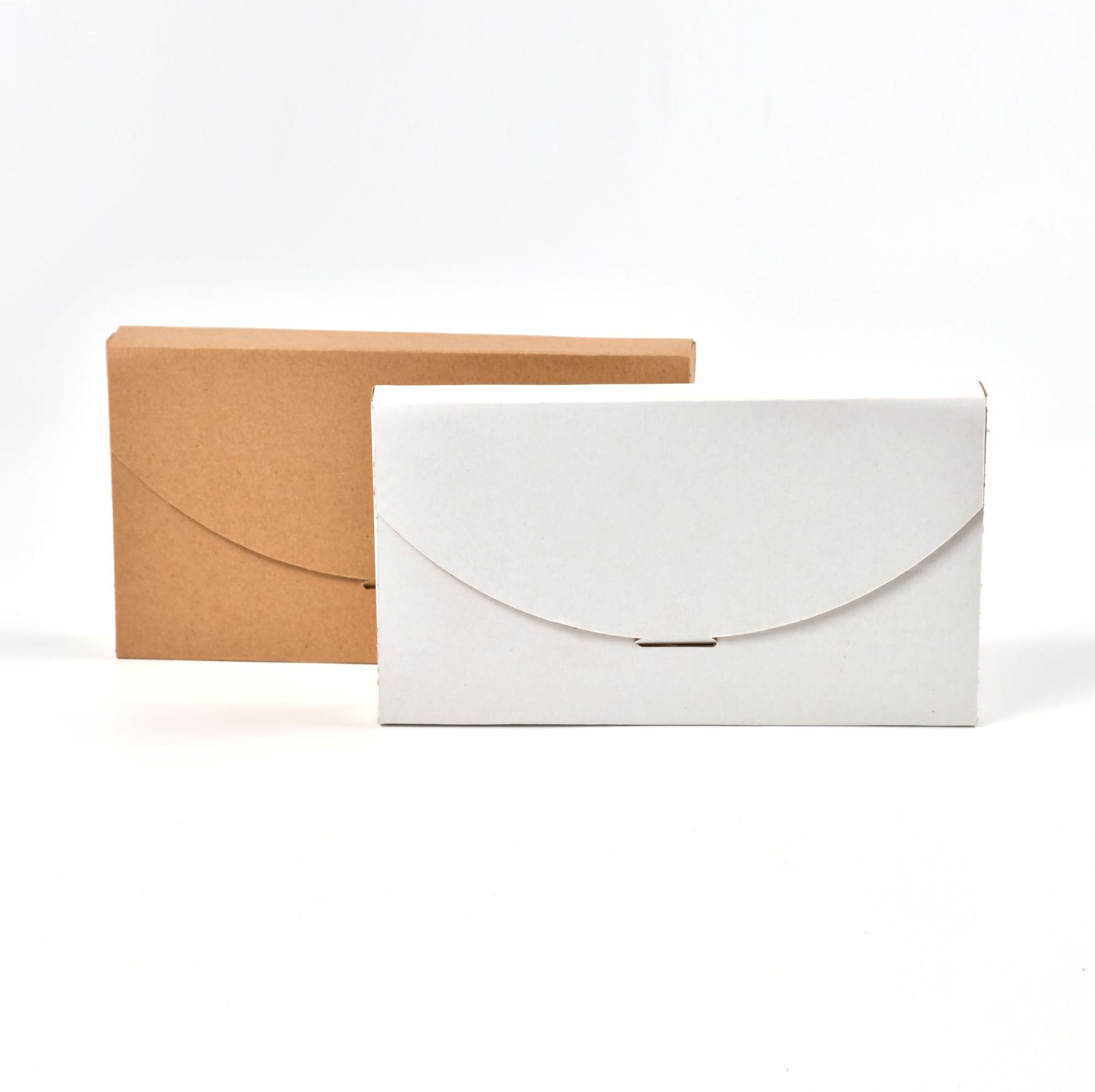
Die-lines often arrive late or only as loose templates, leaving your packaging team to guess where a fold should land or how much clearance the adhesive needs. That guesswork disappears when the cutting path is drawn directly around your product's actual dimensions. Every score, crease, and cut coordinate is measured against the physical item before the first prototype is made, so the box hugs the product instead of forcing it into a generic slot.
The real difference comes from accounting for material thickness and fold behavior on the front end. A rigid corrugated sheet bends differently than a thin folding carton board, and if the die-line treats them as identical, the finished piece will buckle or feel loose. By modeling the exact substrate and checking the inside clearance against a 3D scan of the product, we adjust the line placement until the closed package holds the item with the right amount of tension.
Before any steel rule touches the press sheet, you get a visual proof that overlays the proposed cut path on top of the product outline. That lets you catch misalignment at the desk, not after a full run. It also means the first physical sample is a confirmation of what you already approved, rather than a starting point for revisions.
The Peel-and-Seal Closure That Holds Up Under Rough Handling
Most peel-and-seal strips give up the moment a corner gets crushed or a box gets tossed across a loading dock. This closure takes a different path. The film layer is thick enough to resist punctures from loose hardware or uneven stacking, while the adhesive locks down hard on both virgin and recycled corrugate. Even if the carton flaps shift during transit, the seal stays put instead of peeling back at the edges.
We ran this closure through repeated drop tests, vibration platforms, and rough conveyor simulations. Boxes landed on their corners, slid against abrasive surfaces, and rattled next to heavier freight. What we saw again and again was a seal that didn't crack, curl, or lose grip. The release liner also comes off cleanly in cold or humid conditions, so the initial application doesn't turn into a battle on the packing line.
For anyone shipping tools, industrial parts, or anything that gets handled by people in a hurry, this is the closure that stops tape failures before they start. You get the speed of peel-and-seal with the durability of a far heavier system, and you don't have to double-tape every carton just to feel safe.
How Short-Run Manufacturing Keeps Custom Mailers Affordable for Growing Brands
For emerging labels, the idea of custom mailers often comes with a mental price tag that seems out of reach. Traditional packaging suppliers push large minimum orders, forcing small brands to buy thousands of units upfront just to get a reasonable per-piece cost. Short-run manufacturing flips that model. By using digital printing and streamlined die-cutting setups, producers can switch between designs without costly plate changes or long setup times. This means a growing brand can order five hundred mailers instead of five thousand, pay a slightly higher unit price but a much lower total invoice, and avoid tying up cash in boxes that sit in a garage for two years. The savings aren’t just financial—they’re strategic, letting small teams test new sizes, switch branding between product lines, or run seasonal campaigns without betting the whole budget on one packaging design.
Another quiet advantage is the reduction in waste. Long-run manufacturing often forces brands to over-order “just in case,” leading to obsolete stock when a logo changes or a mailing campaign flops. Short runs let you order closer to actual demand, reordering quickly when inventory runs low. For a growing brand with fluctuating sales months, that flexibility is worth more than a few pennies saved per unit on a bulk order. The ability to iterate on unboxing experience—adding a tissue paper insert one month, switching to a tear strip the next—keeps packaging fresh without a warehouse full of outdated materials. In practice, many short-run suppliers now offer online quoting tools that show real-time pricing for quantities as low as 100, making custom mailers not just affordable but genuinely accessible to businesses that used to settle for plain poly bags.
From Recycled Liners to Water-Resistant Coatings: Picking Materials That Last
The mistake people make with recycled liners is assuming the recycling process strips all performance. It doesn’t. What changes is fiber length and consistency. A 100% post-consumer liner often feels softer for the first few weeks, then starts pilling at the abrasion points. We’ve had better luck with blends that keep at least 30% virgin fiber, or with liners that use mechanically recycled nylon rather than PET—fewer broken filaments over time.
Water-resistant coatings have a similar trap. The cheap versions rely on a simple surface spray that washes off after a handful of rainstorms. A coating worth paying for bonds into the outer fabric at the molecular level, and it should be tested after abrasion, not just on a new jacket. If the spec sheet only shows a spray rating from day one, it’s hiding the real story.
That’s the core rule: test the combination, not the components. A beautiful liner inside a shell with an excellent coating is useless if the liner pills and clogs the membrane, or if the coating delaminates along the shoulder seams. Run a sample through at least 20 wet-dry cycles and a few hours in a pack strap simulator before committing. That’s how you pick materials that actually last.
Inside Our Flex, Drop, and Seam Integrity Checks Before Any Box Leaves the Floor
Every carton gets a few deliberate bends along its main panels before it’s stacked for shipment. A quick hand flex along the long edge, then a gentle reverse press across the width, shows us if the corrugated medium has cracked or if the linerboard is separating. We don’t rely on a single sample from the batch—each box goes through this motion on both ends, because stiffness problems often hide in a corner radius or a die-cut handle zone.
Drop testing isn’t saved for a lab bench. We lift each sealed prototype—and later, every production run’s first few units—to shoulder height and let them hit the concrete flat, corner-first, then edge-first, then face-first. What we’re listening for is a dull crunch that means the flutes have crushed inward, or the sharp snap of a taped seam letting go. If a box passes with nothing more than a scuffed corner, it gets loaded. If we hear that telltale crackle, the whole pallet gets pulled aside and the fluting profile is checked against the spec.
Seam integrity gets a slower, more deliberate check. We run a fingertip under every manufacturer’s joint and every tape line, feeling for gaps where adhesive didn’t wet out fully. Then we press outward from the inside with a rounded tool—not a knife—to see if the joint can take the same pressure a packed box will feel when it’s stacked five high. Any box that opens more than a hair’s width at the seam is rejected and sent back to the glue station. It’s not flashy, but it’s why our boxes survive courier hubs and warehouse racking without popping along the sides.
FAQ
We build them from the ground up around your product dimensions, so there’s no wasted space or added filler. The board grade, tear resistance, and closure style are all matched to how your items actually travel.
Yes. We use reinforced side seams and crush-resistant flute or solid board depending on weight. For dense products, we often add a tear strip or reinforced bottom tuck so the mailer survives rough handling.
Absolutely. Inside printing is useful for branding moments or return instructions. We can run single-color flexo or full digital print on the interior, though most clients keep the inside uncoated for easy recycling.
Size, board thickness, adhesive strength, tear strips, perforations, window patches, and full-color graphics. You can start with a blank structural shell and add only the features your fulfillment team actually needs.
We control moisture during storage and use balanced liners on both sides. The scoring depth is adjusted to the board caliper, so the fold lines stay crisp but don’t crack when the mailer is assembled.
They’re built for that. The mailers maintain their shape after repeated drops, and the self-locking bottom or adhesive strip can be spec’d for fast packing. We also test them with weighted drop simulations before finalizing the structure.
We use Pantone matching on coated and kraft surfaces. If you need a specific uncoated finish, we’ll provide drawdown proofs first so you can see how the ink sits on the actual board.
After artwork approval, structural samples take about five business days, and full production runs usually ship within two to three weeks. If you need a rush order, we can often collapse that by running overtime on existing tooling.
Conclusion
Our envelope mailers begin with caliper-tested board, not the generic stock many converters run by default. We measure thickness at multiple points across each sheet because a half-mil drift changes how a box folds, how it cushions, and whether it arrives looking sharp. From there, every die-line is drawn around your product's actual dimensions—no forcing a square peg into a rectangular slot. The peel-and-seal strip isn't an afterthought; it's engineered to survive rough courier handling, temperature swings, and repeated opening attempts before the final press. Short-run production keeps the door open for growing brands that don't want to tie up cash in thousands of units while they're still iterating on sizing or unboxing flow.
Material choices run from recycled liners that still hold a clean print to water-resistant coatings that shrug off rain and spills without delaminating. Before any box leaves the floor, we run flex, drop, and seam integrity checks—bending corners past their expected angle, dropping loaded samples from counter height, and pulling at glue joints until they fail. That sequence catches the failures a visual inspection misses. The result is a mailer that doesn't just look custom; it behaves like a custom piece of packaging should, batch after batch.
Contact Us
Contact Person: Tan Xiang
Email: [email protected]
Tel/WhatsApp: 8613798906863
Website: https://www.dgkjzx.com