

Karate Hand Guards Maker Crafting Durable Protection for Martial Artists
2026-11-16
When a karateka steps onto the mat, every strike counts—and so does the gear that shields their hands. Not all hand guards are built to survive relentless training. That's where a dedicated karate hand guards maker comes in. At PandaWin Sports, we craft protection that fuses time-tested materials with modern precision, so martial artists can train harder without second-guessing their equipment. But what really separates durable protection from the rest? Let's dig in.
What Actually Happens to Cheap Guards After Three Months of Dojo Use
The first thing you notice isn't a catastrophic failure—it's the quiet creep of degradation. The stitching around the wrist straps starts to fray, not dramatically, but enough that you begin double-checking before each session. The foam padding, which felt reassuringly stiff on day one, now compresses under a firm grip and doesn't fully rebound. After three months of regular dojo use, the cheap guards have developed a permanent set of creases where your hand flexes, and that once-flat inner lining has started to peel away in small, gritty flakes that end up inside your glove.
Protection becomes a matter of trust, and trust erodes faster than the material. A stray shinai strike that would have been a dull thud weeks ago now sends a sharper jolt through the knuckle area. You start adjusting your kamae, unconsciously keeping your hands a few centimeters farther back—not because the guard failed completely, but because you've learned that its impact absorption is now unreliable. The elastic cuff, stretched from daily pulling and tugging, no longer sits snugly against your wrist, leaving a gap that catches the edge of your dogi and chafes.
By the end of three months, the cheap guards are still technically in one piece, but they've transformed from protective equipment into a nagging liability. The synthetic leather has cracked in the high-flex zones, the dye has bled onto your hands after sweaty keiko, and there's a faint but persistent smell that no amount of airing out seems to fix. You realize that replacing them isn't a matter of preference anymore—it's a small but necessary investment to avoid a deeper bruise or a torn callus in the middle of practice.
Layered Foam vs. Single-Density: The Sweet Spot for Karate Impact
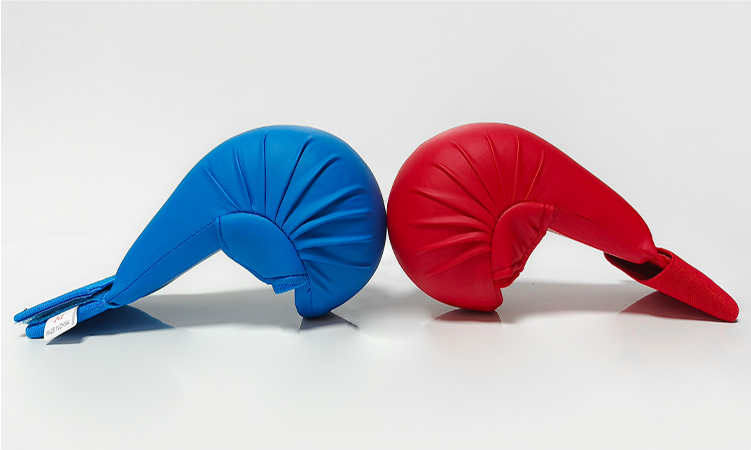
Single-density foam tends to behave the same way under every strike, which sounds consistent until you realize a light jab and a full-power reverse punch demand very different responses. The material either compresses too early and bottoms out on heavy hits, or stays too stiff for quick, snapping contact. Layered foam changes that by stacking densities: a softer outer layer takes the initial edge off, a firmer core stops the force from traveling through, and the transition between them spreads the energy over a slightly longer moment. That wider absorption window is exactly what karate needs, where strikes arrive fast but also carry real weight behind them.
From a training perspective, the difference shows up in how a pad feels after thirty minutes of continuous combinations. Single-density padding can start to feel dead or overly springy, pushing back unevenly as the foam fatigues. A well-built layered setup maintains a more predictable response because each layer has its own job instead of one density trying to handle everything. You also avoid the harsh "slap" that comes from hard foam snapping back too quickly, and you don't get the mushy collapse that happens when soft foam alone can't cope with a strong kick. That balance matters more than raw thickness or density numbers on a spec sheet.
That said, not every layered foam is automatically the right choice—too many layers or wrong densities can create dead spots or sluggish rebound. The real sweet spot sits in a two- or three-layer construction where the outer shell gives just enough under a fast hand strike, the middle layer compresses progressively for roundhouse kicks, and the base layer stays firm enough to protect shins, ribs, and joints. When that stack is tuned properly, the pad feels neither like a pillow nor a brick, and that's the signal you've found the right balance for karate impact.
Measuring Your Hand for a Guard That Stays Put in Kumite
A guard that shifts mid-kumite usually comes down to one overlooked number: the width across your knuckles, not just your palm circumference. Wrap a flexible tape measure around the widest part of your hand—just below the knuckles, excluding the thumb—and note that in centimeters. Then measure from the base of your wrist to the tip of your middle finger. Many fighters pick a size based on glove size from regular training, but kumite guards sit closer to the hand, so even a half-centimeter difference in knuckle width changes how the strap locks over the back of your hand.
For a guard that stays put, compare your two measurements against the maker’s specific chart instead of relying on S/M/L tags. If you land between sizes, go with the smaller one only if you plan to wear it bare-handed; add a size up if you wrap your hands or use a thin liner. After you put it on, close the strap and make a tight fist. The fabric should feel snug across the knuckles without cutting off circulation, and the wrist closure should not ride up when you snap a reverse punch. If the guard slides toward your fingers during a few shadow exchanges, remeasure the width just below your knuckles—many people compress that area when they measure, which leads to a loose fit later.
The Stitching Detail That Keeps Edges from Splitting Under Pressure
Most edge failures start small — a single thread loosens, then the weave around it begins to pull apart. The right stitching detail stops that chain reaction before it begins. By running a second line of stitching just inside the first, the fabric’s tension gets spread across two anchors instead of one. That means when a seam is yanked, twisted, or loaded unevenly, the stress doesn’t concentrate at the very edge where the material is weakest.
It’s not just about adding more thread. The angle and spacing matter just as much. A tight zigzag or a welted edge can create a slight ridge that keeps the raw fibers from flexing outward under load. In heavy canvas and leather, this detail is what lets a corner survive being dragged across concrete. The outer edge may scuff, but it won’t split open along the stitch line because the reinforcement is doing its work underneath.
You’ll notice the difference on high-stress points like strap attachments, pocket corners, and hem edges. The stitching looks intentional, almost decorative, but it’s placed where the fabric would otherwise tear first. Once those edge fibers are bound down properly, the whole piece feels more solid in the hand — and it stays that way long after weaker seams would have given out.
Breaking In Without Breaking Down: A First-Week Wear Plan
A brand-new pair of shoes often feels like a negotiation between your feet and the leather. That stiffness isn’t a flaw; it’s the material holding its factory shape. The trick to breaking them in isn’t forcing long hours from day one. It’s about short, intentional wear that lets the shoe learn your stride while your feet adjust to the new pressure points. Start with thirty minutes around the house on day one, then run a quick errand on day two. The goal is to crease the sole and soften the upper without creating a single blister.
By midweek, you can stretch the timeline. Wear them to the office or on a slow walk for a couple of hours, but keep a backup pair nearby. If you feel a hot spot forming, switch shoes immediately—pushing through only guarantees a raw heel tomorrow. Socks matter more than most people admit. Thicker wool or padded running socks create a buffer that mimics the break-in process without the pain. Some people also swear by a thin layer of moleskin on the back of the heel before the first few outings.
By day six or seven, the shoes should feel noticeably more forgiving. If they still pinch across the ball of the foot or slip at the heel, don’t panic. A cobbler can stretch a tight toe box, and a heel grip insert fixes minor slippage. The real failure is giving up after one painful day. Break them in like you’d break in a new habit: steady, low-pressure, and with a little forgiveness for the rough patches.
When to Replace Your Hand Guards—Signs Most People Miss
Most riders wait until a hand guard is visibly cracked or dangling before swapping it out, but the real warning signs show up much earlier. Hairline fractures around the mounting bolts are easy to dismiss as surface scratches, yet they spread with every vibration from the road. By the time you hit a rough patch and the guard finally snaps, your hand is left completely exposed.
Another overlooked clue is the feel of the material itself. If the guard no longer has that slight flex and instead feels stiff, brittle, or tacky to the touch, UV exposure has likely degraded the plastic or composite. A guard that has lost its elasticity won't absorb impact by bending—it will shatter, which can cause more harm than no guard at all.
Don't just focus on the guard body; the hardware fails quietly too. Check bolts, washers, and mounting brackets for rust or deformation. Even if the guard looks intact, a loose bracket can shift during a crash and fail to cover your hand properly. Make it a habit to press on the guards and wiggle the mounts before long rides, and replace anything that creaks, shifts, or feels loose.
FAQ
They combine a full-grain leather outer shell with high-density foam that absorbs impact without flattening over time. Every seam is double-stitched, which stops the padding from shifting even during heavy bag work.
Yes. Instead of just small, medium, large, the maker offers a measurement-based sizing chart that uses palm width and knuckle circumference. You can also request a custom fit for a small extra charge.
A wide hook-and-loop strap wraps around the wrist at two angles, plus a silicone grip strip inside the palm area. That keeps the guard from rotating when you throw hooks or backfists.
The interior uses a moisture-wicking mesh that pulls sweat away from the skin, and there are perforations along the finger openings. You won't end up with that soaked, heavy feeling after an hour of kumite.
Wipe the outer leather with a damp cloth and let them air dry away from direct sunlight. Every few weeks, a light leather conditioner keeps the shell from cracking. Don't machine wash or soak them.
They're built primarily for karate striking and blocking, but the open-finger design and wrist support work fine for light kickboxing drills. For heavy grappling or ground-and-pound, you'd want a different glove style.
Each pair is cut and stitched after you order, so expect about 7 to 10 business days before shipping. Custom sizing or monogramming adds another 3 days.
You have 30 days to return unused guards in their original condition. If the issue is a sizing mistake on the maker's end, they cover return shipping and build a replacement pair.
Conclusion
After a few months of regular dojo training, most budget karate hand guards start to tell a familiar story: flattened padding that no longer softens a solid punch, frayed edges where the fabric gives way, and a fit that shifts mid-kumite. A maker who focuses on durability addresses this by moving beyond single-density foam. Layered foam—usually a firmer core with a softer outer layer—absorbs impact without packing down quickly, so the guard keeps its protective curve even when drills get intense. The difference becomes clear after heavy use: instead of that paper-thin feel, you get consistent rebound and shock distribution. Another detail that separates long-lasting guards from throwaways is stitching. Reinforced, bound edges prevent the seams from splitting under the repeated stress of blocks and strikes. Cheap guards often fail at the seam first, but a well-made pair uses double or triple stitching along high-tension zones, keeping the foam inside where it belongs.
Getting the right size matters just as much as construction. Measuring across the knuckles and palm with a relaxed hand, then checking against the maker's specific sizing chart, ensures the guard stays put during fast exchanges—no sliding, no constant readjusting. A first-week wear plan also helps: short sessions at first, gradually increasing time so the guard molds to your hand without breaking down the foam or irritating your skin. Even the best pair won't last forever, and most people miss early warning signs. Look for compressed areas that don't bounce back after a few hours, visible cracks in the outer layer, or a looser fit than when new. If the padding feels hard or thin in spots, or the strap loses its grip, it's time to replace. Paying attention to these cues keeps your hands protected long before a failure happens in the middle of a sparring match.
Contact Us
Contact Person: Fei Xu
Email: [email protected]
Tel/WhatsApp: +8618631245578
Website: https://www.pandawinsports.com/